
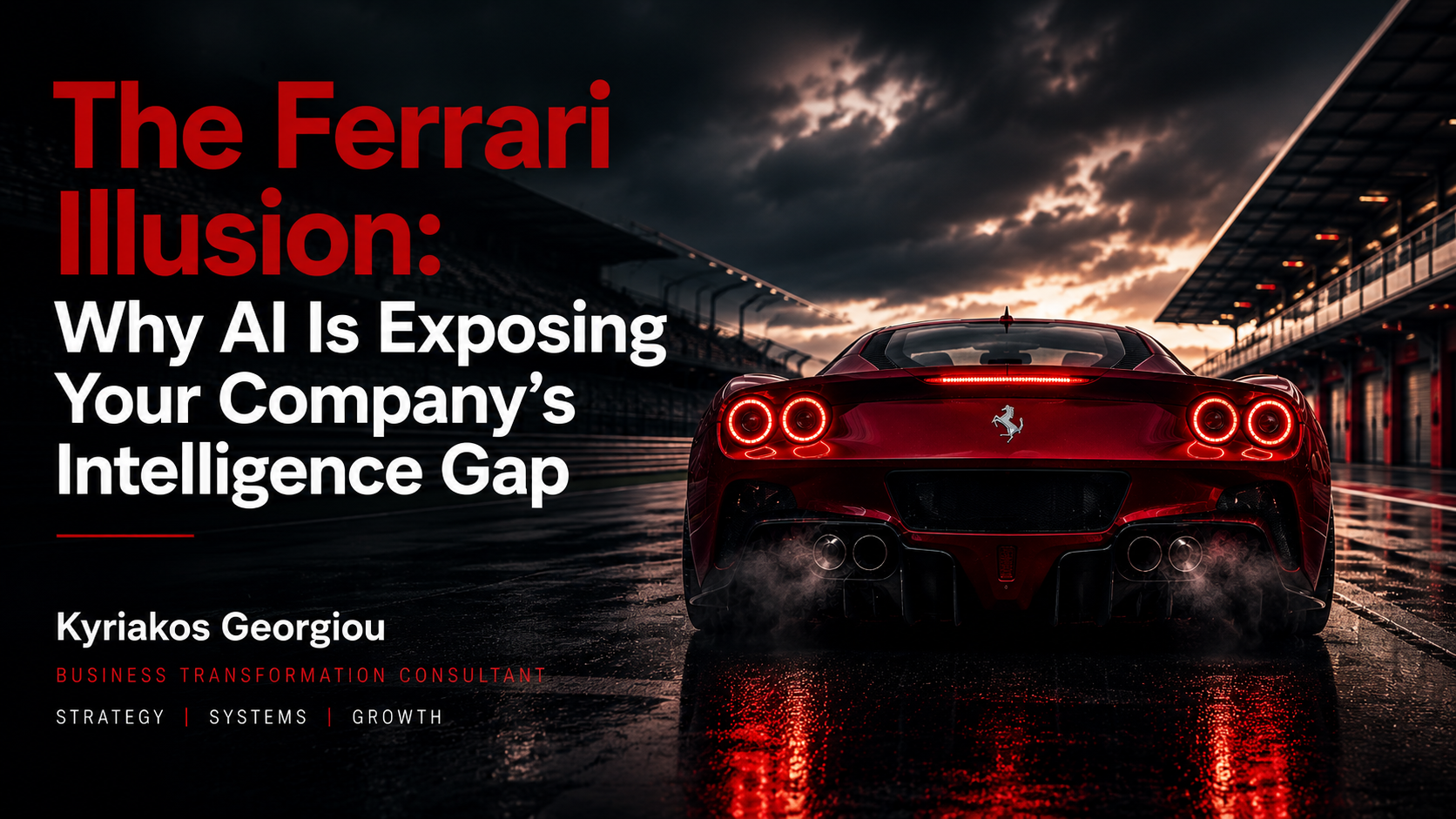
Imagine every company being given the exact same Ferrari . Who wins?
Not the company with the best car, but the one with the best driver, the best engineers, the best strategy, the strongest communication, and the smartest operating model. Now replace the Ferrari with AI. That's the reality every business leader is confronting today. The problem is that most are preparing for the wrong race.
The Wrong Conversation
Every CEO I’ve spoken to over the past year has asked me a version of the same question: “Which AI platform should we use? ChatGPT ? Claude ? Google Gemini ? Microsoft Copilot ?”
It’s the wrong question.
Not because the models aren’t impressive. They are. But because it assumes competitive advantage lies in the technology itself. It doesn’t.
The real competitive advantage has never been access to technology. It has always been the quality of the organization using it. Every serious business can now access AI capabilities that would have seemed extraordinary only a few years ago. The gap between leading models continues to narrow, access is expanding rapidly, and the cost of intelligence continues to fall. Yet most organizations are still approaching AI with a mindset built for a different era.
For decades, businesses were designed around scarcity. Information was scarce. Expertise was scarce. Decisions traveled upwards because knowledge was concentrated at the top. Hierarchies, reporting structures, approval chains, and departmental silos were all logical responses to that reality.
AI fundamentally changes that assumption. Information is becoming abundant. Intelligence is becoming increasingly accessible. Yet most organizations are still operating as though both remain scarce.
The AI race isn’t over. It has simply moved to a different track. The companies that win won’t necessarily own better AI. They’ll build better organizations around it. And that’s where I believe almost every leadership team is looking in the wrong direction.
The Problem Isn’t AI
After working with leadership teams across different industries, I’ve noticed something that almost nobody is talking about: Most companies don’t have an AI problem. They have an Intelligence Gap.
Every organization has someone responsible for finance, marketing, sales, operations, technology, HR, and legal.
But who owns organizational intelligence? Who owns how decisions are made? Who owns how information flows? Who owns how knowledge is challenged before it becomes strategy? Who owns the quality of thinking across the business?
In most organizations… nobody.
Technology has an owner. Intelligence doesn’t. Companies have spent decades appointing leaders to own functions, budgets, and systems, but very few have appointed anyone to own the way intelligence moves through the organization. As a result, AI becomes another technology initiative instead of an opportunity to redesign how the business thinks, decides, and operates. I believe that’s becoming one of the most expensive organizational blind spots of this decade.
AI Isn’t Creating the Problem. It’s Revealing It.
This is the biggest misconception in business today. AI isn’t creating organizational weaknesses. It’s exposing the ones that were already there.
Recently, I realized something while speaking with different leadership teams. Two organizations can buy exactly the same AI.
- One removes unnecessary approvals, redesigns workflows, and shortens decision cycles.
- The other proudly announces that employees can now write reports and summarize meetings faster.
Same technology. Completely different outcome.
Because AI isn’t changing the organization. It’s revealing it. Technology has always been an amplifier. AI simply amplifies faster than anything before it. It doesn’t create organizational intelligence any more than a Ferrari creates a Formula 1 champion. It exposes whether the foundations were strong enough to benefit from speed in the first place.
- Companies with decisive leadership become faster.
- Companies with bureaucracy become more bureaucratic.
- Companies with clear operating models become more effective.
- Companies with fragmented decision-making become even more fragmented.
AI doesn’t reward excellence. It magnifies whatever already exists. That is why some organizations experience transformation while others simply experience faster dysfunction.
The Most Expensive Mistake Companies Are Making
Most organizations think they’re transforming. In reality, they’re automating inefficiency.
They’re taking fragmented communication, redundant approvals, bloated reporting, outdated operating procedures, and unnecessary meetings, then asking AI to execute all of it at machine speed.
Teams that once spent three days writing a report nobody read can now produce that same report in thirty seconds. The output increased. The value didn’t.
That’s not transformation. That’s acceleration without direction. It’s like buying a Ferrari and using it to sit in traffic.
The problem isn’t the car. The problem is where you’re trying to drive it. Technology can accelerate work. It can’t justify unnecessary work. Efficiency applied to unnecessary work is still waste.
The uncomfortable truth is that AI doesn’t eliminate poor management. It scales it. If your organization rewards bureaucracy, AI will help bureaucracy move faster. If your organization rewards intelligent decision-making, AI will amplify that instead. The technology is neutral. Your operating model determines the outcome.
The Intelligence Gap
I believe the defining management challenge of this decade won’t be AI adoption. It will be closing what I call The Intelligence Gap - the gap between how intelligent an organization believes it is and how intelligently it actually operates.
That gap appears everywhere:
- In unnecessary approvals.
- In meetings without decisions.
- In reports without action.
- In departments that don’t share information.
- In leaders making strategic decisions without strategic visibility.
But beneath all of those symptoms sits a deeper issue. Organizations are still designed to manage information rather than intelligence. They optimize reporting instead of learning. They optimize hierarchy instead of judgment. They optimize process instead of adaptability. AI doesn’t create those weaknesses. It simply removes the excuses for keeping them.
AI doesn’t close the Intelligence Gap. It measures it. Then it amplifies it.
The Companies Pulling Ahead Understand One Thing
The organizations creating real competitive advantage aren’t simply adopting AI faster. They’re redesigning how intelligence flows through the business.
They challenge every approval layer. Every recurring meeting. Every workflow. Every report. Every assumption.
They understand that AI isn’t the transformation. It’s the diagnostic. It doesn’t tell you how to build a better business. It tells you, with uncomfortable clarity, how well your business was designed in the first place. That’s why two organizations can invest the same amount in AI and achieve completely different outcomes. One becomes more intelligent. The other simply becomes faster at doing the wrong things.
They ask different questions:
- Which decisions genuinely require human judgment?
- Which workflows should disappear completely?
- Where is bureaucracy creating friction instead of value?
- If we built this company today, would we design it this way?
Choosing between AI models doesn’t create competitive advantage. Answering those questions does.
The Ferrari Was Never the Advantage
Soon, every serious company will have access to extraordinary AI. That isn’t the prediction. That’s the assumption.
The real question is what happens next.
- Some organizations will buy the Ferrari and leave it in the garage.
- Some will drive it like a family hatchback.
- Some will crash it into the first corner.
- A very small number will build an entire racing team around it.
They’ll redesign how decisions are made. How information moves. How work gets done. How accountability works. How leadership thinks.
Those organizations won’t outperform because they bought better AI. They’ll outperform because they built a more intelligent organization. That’s the distinction most businesses still haven’t understood.
The Ferrari was never the competitive advantage. The racing team was.
Which leaves every leadership team with a far more important question than: “Which AI model should we choose?”
Instead, ask: “If every one of our competitors had access to exactly the same AI tomorrow, what would still make us impossible to beat?”
If that question is difficult to answer, your competitive advantage was never AI. It was the organization behind it. And that’s where your Intelligence Gap begins.